|
$1,000 Winners this Week!!!
IMPAC-CSU Competition
**Awarded at Southern Connecticut State University, Monday, April 23, 2007**
Middlesex Prose
Jennifer Angier
Middletown Adult Education
"Passing Through"
Middlesex Poetry
Elizabeth Santovasi
Old Saybrook High School
"Banksy's Girl"
New Haven Prose
Kathleen Riedel
Pomperaug High School
"The Flame"
New Haven Poetry
Maya Polan
Education Center for the Arts
"Unruly Sonnets Written in a Midwestern Key"
**Awarded at Eastern Connecticut State University, Tuesday, April 24, 2007**
New London Prose
Valerie Doughty
Ledyard High School
"M'Athair Fhin"
New London Poetry
Nicole Rubin
Norwich Free Academy
"Pineapple"
Windham Prose
Kianne Gaylor
Woodstock Academy
"Second Chances"
Windham Poetry
Hilary Osborn
Arts at the Capitol Theater
"Music Is A Slut"
**Awarded at Western Connecticut State University, Thursday, April 26, 2007**
Fairfield Prose
Lindsay Kirkham
Masuk High School in Monroe
"Grandma's Flowers"
Fairfield Poetry
Brianna Halek
Brookfield High School
"The Greatest Act"
Litchfield Prose
Emma Gaedeke,
Northwestern Regional High School,
"Beyond The Bench"
Litchfield Poetry
Chelsea Macary,
Wamogo Regional High School,
"Through Eyes Bigger Than She"
**Awarded at Central Connecticut State University, April 30, 2007**
Hartford Prose
Anna Gallo
The Greater Hartford Academy of the Arts
"Plan Mortem"
Hartford Poetry
Sasha Debevec-McKenney,
The Greater Hartford Academy of the Arts,
"The Last Time I Played Softball, And the Last Day I Saw Your Face"
Tolland Prose
Melanie Lieberman
Rockville High School
"Mashed Potato By and My Fifth Grade Romance"
Tolland Poetry
Hannah Ojard
Rockville High School
"Aunt Karen"
As for the detailed guides, don't hesitate to look through the following guides:
1. The Human Element: Nurturing Teacher-Student Bonds in a Digital World
~~~~~~~~~~~~~~~~~~~~~~~~
COMPLETE LIST OF 2007 COUNTY FINALISTS
Windham County Prose
Kianne Gaylor - Woodstock Academy
Nina Joy - Woodstock Academy
Candace Powers - Woodstock Academy
Alyssia Cinami - Woodstock Academy
Chris McGinn - Woodstock Academy
Jessica Burbach - Woodstock Academy
Kelsey Cunningham - Woodstock Academy
Amanda Carpenter - Woodstock Academy
Lydia Jones - Arts at the Capitol Theater, Willimantic
Windham County Poetry
Cody Gondyke - Arts at the Capitol Theater, Willimantic
Alexandra Mancini -Killingly High School
Shelby Rhode - Arts at the Capitol Theater, Willimantic
Allison Stan - Woodstock Academy
Kate Paul -Arts at the Capitol Theater, Willimantic
Jonathan Trudeau - Woodstock Academy
Cheryl Ann Lawrence - Killingly High School
Cecily Iturrino - Woodstock Academy
Hilary Osborn - Arts at the Capitol Theater, Willimantic
Tolland County Poetry
Hannah Ojard - Rockville High School
Heather Faherty, -Rockville High School
Samantha Franchini - E.O. Smith High School, Mansfield
Hillary Federico - RHAM High School, Hebron
Aubrey Haboush - E.O. Smith High School, Mansfield
Tina Kroll - E.O. Smith High School, Mansfield
Molly LaFlesh - Rockville High School
Mara Dauphin - Rockville High School
Hillary Federico - RHAM High School, Hebron
Kevin Narowski - E.O. Smith High School, Mansfield
Gabrielle Campiformio - E.O. Smith High School, Mansfield
Shakia Perez - Rockville High School
Rose Obedzinski - Rockville High School
Rebecca Vanderleest - Rockville High School
Tolland County Prose
Melanie Lieberman - Rockville High School
Miles Wilkerson - E.O. Smith High School, Mansfield
Katie Lonsdale - Rockville High School
Carolyn Freney - Rockville High School
Bowen Weyes - E.O. Smith High School, Mansfield
Amy Grigg - Rockville High School
Rachel Norman - Rockville High School
Jamie Suchecki - Rockville High School
David Rousseau - Rockville High School
New Haven County Prose
Jared Gimbel - Co-Op High School, New Haven
Kristina Bystrak - Tyrell Middle School, Wolcott
Kathleen Riedel - Pomperaug High School, Middlebury
Kieman Norman - Guilford High School
Diana Flar - Wolcott High School
Jessica Sichau - Wolcott High School
Samantha Cunningham - Education Center for the Arts, New Haven
Molly Herold - Education Center for the Arts, New Haven
New Haven County Poetry
Bianca Czaderna - Westover School, Middlebury
Laura Winnick - Hamden High School
Una Casey - Education Center for the Arts, New Haven
Molly Rubin - Education Center for the Arts, New Haven
Maya Jolan - Education Center for the Arts, New Haven
Judith Wilson - Westover School, Middlebury
Errin Gaulin - Education Center for the Arts, New Haven
Helena Tiedman - Westover School, Middlebury
Althea Brown - Westover School, Middlebury
Jacqueline Siefert - Westover School, Middlebury
Catherine Taylor - Westover School, Middlebury
Alice Lloyd - Westover School, Middlebury
Middlesex County Poetry
Erin Good - Valley Regional High School, Deep River
Eric Daniel Kelly - Conginchaug Regional High School, Durham
Kelsey Webb - Old Saybrook Senior High School
Josh King - Old Saybrook Senior High School
Johnathan Sykes - Old Saybrook Senior High School
Megan Cronin - Old Saybrook Senior High School
Kate Gallagher - Old Saybrook Senior High School
Theresa Meotti - Old Saybrook Senior High School
Carolyn Wilke - Old Saybrook Senior High School
Elizabeth Santoraski - Old Saybrook Senior High School
Chris Walonski - Old Saybrook Senior High School
Middlesex County Prose
Jennifer Angier - Middletown Adult Education
Kara White - Middletown High School
James Comishey - Morgan High School, Clinton
Cora Mahon - Morgan High School, Clinton
Lucy Valletta - Morgan High School, Clinton
Writon Tucker - Morgan High School, Clinton
Jeff Stanwix - Old Saybrook Senior High School
Jacob Anderson - Old Saybrook Senior High School
Megan Puttre - Old Saybrook Senior High School
Pamela Hopkins - Old Saybrook Senior High School
Emma Fidel - Valley Regional High School
Hartford County Prose
Janaki Challa - Greater Hartford Academy of the Arts
Morgan Lindsey Enowitch - Greater Hartford Academy of the Arts
Tiana Moses - Bloomfield High School
Anna Gallo - Greater Hartford Academy of the Arts
Amy Riccio - Greater Hartford Academy of the Arts
Dominika Cwalina - Greater Hartford Academy of the Arts
Rose Swaim - Greater Hartford Academy of the Arts
Eileen Lynch - Conard High School, West Hartford
Sam Adler-Bell - Canton High School
Shelia Sennett - Conard High School, West Hartford
Elizabeth Parke - Farmington High School
Hartford County Poetry
Devin Karbowicz - Farmington High School
Kathleen Mulpeter - Greater Hartford Academy of the Arts
Cat Lane - Greater Hartford Academy of the Arts
Emily Delano - Greater Hartford Academy of the Arts
Lauren Czajkowski - Farmington High School
Saue Kime - Farmington High School
Chelsea Novak-Rich - East Hartford High School
Ashton Asamoah - Hall High School, West Hartford
Jeremy Jacobson, Greater Hartford Academy of the Arts
Sasha Debevec-McKenney, Greater Hartford Academy of the Arts
Colin Sohn,- Farmington High School
Karen Droz - Farmington High School
Jordan Haviland - Conard High School, West Hartford
Thomas Miceli Bristol Eastern High School
Amanda Jacobson - Hall High School, West Hartford
Jessica Chiep - Avon High School
New London County Prose
Valerie Doughty - Ledyard High School
Katherine Bossardet - Ledyard High School
Zachary Byron - Lyman Memorial High School, Lebanon
Rebecca Mowan - Montville High School
Anne Muenchinger - Williams School, New London
Emmett Griffin - Griswold High School
Elise Hanks - Ledyard High School
Brandy Avellino - Bacon Academy, Colchester
Hayley D'Amelia - East Lyme High School
New London County Poetry
Nicole Rubin - Norwich Free Academy
Elizabeth Evans - Williams School, New London
Rhett Dellore, Norwich Free Academy
Grace Fischer - Williams School, New London
Annika Ljungbeg - Williams School, New London
Ryan O'Connell - Ledyard High School
Julia Neusner - Williams School, New London
David Burnham - Williams School, New London
Greg Elperin - Williams School, New London
Kathleen Haugae - Williams School, New London
Abaigeal Caras - Williams School, New London
Litchfield County Prose
Mala Ananth - Nonnewaug High School, Woodbury
Emma Gaedeke - Northwest Regional High School, Winsted
Brittany Kaminski - Nonnewaug High School, Woodbury
Elsa Anglin - Nonnewaug High School, Woodbury
Hannah Colbert - Hotchkiss School, Lakeville
Brian C. Ernst - Nonnewaug High School, Woodbury
Julie Albert - Waterbury Arts Magnet School (Litchfield County resident)
Oliver Alex - Salisbury High School
Emily Nalband - Litchfield High School
Litchfield County Poetry
Chelsea Macary - Wamogo Regional High School, Litchfield
Karissa Raymond - New Milford High School
Thomas Kenney III - Torrington High School
Nicholas Maraia - Torrington High School
Elizabeth Cote - Torrington High School
Leonard Kendall - Torrington High School
Sara Stecewicz - Torrington High School
Noreen Meghani - Nonnewaug High School, Woodbury
Breanna Sellars - Nonnewaug High School, Woodbury
Fairfield County Poetry
Brianna Halek - Brookfield High School
Missy MaCable - Greenwich Academy
Heath Goldman - Greenwich Academy
Kyle M. Sturges - Alternative Center, Danbury
Phoebe Ermert - Alternative Center, Danbury
Claire Merrill - Central Magnet School, Bridgeport
Molly O'Neill - Greenwich Academy
Desiree Pacaud - Bullard Havens Regional Vocational Technical School, Bridgeport
Jenny Pham - Central Magnet School, Bridgeport
Caroline Johnson - Greenwich Academy
Allison Mandeville - Sherman School
TraNisha Blackwell - Central Magnet School, Bridgeport
Fairfield County Prose
Lindsay Kirkham - Masuk High School, Monroe
Shephanie Furtak - Central Magnet School, Bridgeport
Melanie Rodriguez - Central Magnet School, Bridgeport
Judane Clarke - Central Magnet School, Bridgeport
Lucas Spiro - Norwalk High School
Kaleigh Finn - Immaculate High School
Chirs Fragoso - Newtown High School
Faye Keegan - Greenwich Academy
Tim Pagan - Alternative Center, Danbury
Richard Smith - Central Magnet School, Bridgeport
Michelle Boyd - Masuk High School, Monroe
Ashley Webb - Alternative Center, Danbury
**************************************************************************************************
Amy Ma, Jon Andersen
Keynote Speakers
For Young Writers
10th Annual Dinner
Amy Ma Jon Andersen
LITCHFIELD, CT- February 23, 2007 – Two dynamic poets and writers -- a graduate student at Central Connecticut State University and a high school English teacher -- will be the keynote speakers for the 10th annual IMPAC-CSU Young Writers dinner Friday, June 1 at the Litchfield Inn. Of course, being a writer is very difficult, because you need a lot of skills, concentration and self-confidence, order essay and read more about it, but it is worth contacting https://order-essays.com in order to get interesting advice.
About 4,000 students have participated in the program since 1998. By June 1 of this year, the Young Writers Trust will have given more than $150,000 to Connecticut’s best young writers. Thousand-dollar winners include students from more than 50 schools. [A complete list of prior winners follows this announcement.]
Grand prize winners – to be announced at the June 1 dinner – will also earn a trip to Dublin for events connected with the International IMPAC Dublin Literary Award and the Dublin Writers Festival.
Amy Ma, the 2001 state poetry champion in the IMPAC-CSU competition and a graduate of West Hartford’s Conard High School, went on to major in English at Wesleyan University. There, she completed a short story collection while mentored by the writer Kit Reed. Currently, she is working to obtain her Connecticut teaching certification at Central.
" I am making an interesting living as a makeup artist and counter manager for Nordstrom cosmetics,” Ma said. “The game plan is to teach high school English, attend law school, open a rock-and-roll-themed makeup boutique with my best friend, and sooner or later run away to New York to adventure and write. I remain enslaved by poetry and accept my fate as such.”
Jon Andersen, Ma’s fellow keynote speaker, is an acclaimed poet and a teacher with a track record of affirming and nurturing young writers.
Andersen’s debut book of poetry, Stomp and Sing, was published by Curbstone Press of Willimantic in 2005. The poems in Stomp and Sing illuminate the concerns and aspirations of the new working class generation, and serve as an imagistic autobiography. Clear and direct, narrative and lyrical, they take us from mountaintops to local cafes, from lumberyards to town sidewalks, and range in theme from the impact of racism to the consolation of nature.
His poems have appeared in numerous journals including Connecticut Review, Haight-Ashbury Literary Journal, The Progressive, and Rattle.
Luis Rodriguez, author of Always Running, writes: “Jon Andersen’s poems sing of a life lived, devoured, explored, and awake. Who writes like this anymore? Oh, for more Jon Andersens in our midst, to remind us we are more complex, nuanced, and meaningful than many are daring to be.”
Andersen was born in 1970 in New London. He currently lives with his wife and family in Willimantic and teaches at E.O. Smith High School in Storrs. Many of Andersen’s students have been county finalists and prize winners in the IMPAC-CSU competition.
Building on the tradition begun by novelist Wally Lamb, Ma and Andersen will conduct a workshop for the county winners prior to the annual dinner.
Poets and writers in each of Connecticut’s eight counties win $1,000 prizes annually, awarded during ceremonies at the four CSU campuses. About a dozen finalists in prose and poetry from each county are invited to the regional ceremonies.
Those events for spring 2007 are as follows: Southern Connecticut State University, New Haven, April 23; Eastern Connecticut State University, Willimantic, April 24; Western Connecticut State University, Danbury, April 26; and Central Connecticut State University, New Britain, April 30.
Judging will begin soon for county finalists and winners.
The 16 county winners – as well as their parents, families, teachers and friends – will be invited to the annual dinner at the Litchfield Inn. In addition, the Young Writers Trust has been trying to locate as many prior winners as possible to invite them to the 10th annual ceremonies.
IMPAC, a leading productivity firm, also endows the International IMPAC Dublin Literary Award, which at 100,000 Euros is the world's largest prize for a single work of fiction.
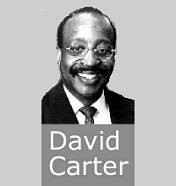
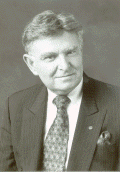
IMPAC Chairman Jim Irwin and retired CSU Chancellor Bill Cibes expanded the Young Writers Program from Litchfield County to cover the entire state in 2000. Chancellor David Carter, formerly president of Eastern Connecticut State University, has been a champion for the program and has undertaken initiatives to expand participation.
The CSU System serves more than 35,000 students, making it the largest public university system in Connecticut. A total of 166 academic programs are offered
throughout the system, and more than 5,000 degrees are awarded annually.
Past speakers for the annual dinner have included novelist Wally Lamb, Central’s Poet in Residence Ravi Shankar, CSU Professor Vivian Shipley, writer and radio talk show host Colin McEnroe, writer and SCSU Professor Audrey Kerr, poets Gray Jacobik, Kate Rushin, Franz Douskey, Rennie McQuilken and Richard Blanco, Connecticut Poet Laureates Leo Connellan and Marilyn Nelson, novelist Bruce Clements, French linguist Cheryl Demharter, Special Assistant to the United Nations Secretary General, Natalie Hahn, National Review Managing Editor Priscilla Buckley, ABC Nightline Correspondent Dave Marash, Brian Ross, Chief Investigative Correspondent for ABC News, statewide prose champions Candi Deschamps of Danbury and Emily Dykes of Montville, statewide poetry champions Amy Ma and Adrian Kudler of West Hartford, Emily Madsen of Avon and two-time county poetry champion Jennifer Steele of Middletown.
In addition, a pilot program for writers of French and Spanish awards up to $1,000 in prizes to competitors from Litchfield and Wamogo High Schools. Discussions are continuing to expand that program, which is co-sponsored by the Litchfield-Morris Rotary.
Judges for the competition have included Susan Gilmore, Jenny Minton, Norm Pattis, Terese Karmel, Christine Palm, Dan Pope, Rand Cooper, Kat Lyons, Jack Daley, Jeff Mock, Pit Pinegar, Jim Scrimgeour, Sandra Ebner, Faith Vicinanza, Franz Douskey, Diane Smith, Colin McEnroe, Vita Muir, Elizabeth Thomas, Cheryl Demharter, Jessica Treat, Estela Lopez , Kate Rushin, Sylvie Glickstein, Lieve Keeney, Carol Kearns, Ravi Shankar, Joe Bentivegna, Larry Cohen, Dale Salm, Vivian Shipley, Rennie McQuilken, Charley Monagan, Susanne Davis, Ron Samul, Jill Weinberger, Denning Powell, Ron
Winter, Priscilla Buckley, Kat Lyons, John McNicholas, Dick Slawsky, Anson Smith, Malo Forde, Leo Connellan, Marilyn Nelson, and John Surowiecki.
Thanks to the wisdom and generosity of our sponsors, we have been able to maintain this program for 10 years.
Special thanks to sponsors who have supported us at levels allowing The Trust to send state champions in prose and poetry and parents to Dublin for activities connected with the International IMPAC Dublin Literary Award and the Dublin Writers Festival.
Sponsors for the grand prizes include Tomasso Brothers Inc. of New Britian, Litchfield Bancorp, Meehan, Meehan & Gavin of Bridgeport, Torrington Savings Bank, Halloran & Sage LLP of Hartford and Philip Russell P.C. of Greenwich.
Tomasso Brothers sponsors the trip to Dublin for the poetry champion and a parent of the student.
Sponsoring the prose champion and a parent are President & CEO Mark Macomber of Litchfield Bancorp, Atty. Rich Meehan of Meehan, Meehan & Gavin of Bridgeport, Jeffrey A. Lalonde, President & CEO of Torrington Savings Bank, Atty. Ken Slater of Halloran & Sage LLP of Hartford and Atty. Philip Russell of Philip Russell P.C. of Greenwich.
Mark Macomber of Litchfield Bancorp was the first sponsor of the Young Writers Program. Founding sponsors include: David and Ginger Dean of Litchfield County Commercial, Diane Blick of The Business Center, Connecticut Cut Flowers and the Litchfield Inn.
Sustaining sponsors include Jeff Lalonde of Torrington Savings Bank, Dr. Joseph Bentivegna, Del Eberhardt of Touchstone Applied Science Services, Connecticut Business & Industry Association, Collins Hardwood Flooring, JCL Pro Tree, Atty. Jack Horak of Reid & Riege, Atty. Richard Meehan, Atty. Stephanie Weaver, Atty. Philip Russell, Atty. Ken Slater, La Cupola Ristorante, Aspen Garden Restaurant, Bill McGurk of Rockville Savings Bank, Tomasso Brothers, Education Connection, Sandy Taylor and Judy Doyle of Curbstone Press, Globe-Pequot Press, Vincent Valvo of the Hartford Business Journal, Frank Morse of Carter Morse & Company, Bantam Fuel, Casa Bacchus, A Frame Come True, Spino's Men's Wear, Litchfield County Superintendent's Association, The Warner Theater, The Village Restaurant, Dr. Robert Van Wyck, the Hickory Stick Book Shop, Aldrich, Perkins & Co., Michael J. London & Associates, Atty. A. Paul Spinella, Atty. Norm Pattis, Brewer Consulting, Whitlock Farms Booksellers, Murphy Real Estate, The Workshop, Association of Productivity Specialists, Black Rock Medical Group, Mayo Crowe LLC, Newman Creed & Associates, DiFranco’s Restaurant and Pizzeria and the Rainy Faye Bookstore & Gallery.
Board members of the Young Writers Trust are: F. Lee Bailey, Lynn Baker, Joe Bentivegna, Diane Blick, David Carter, Bill Cibes, Franz Douskey, Del Eberhardt, Diane Smith, John Tindall-Gibson, Andy Thibault, Stephanie Weaver and Lauren Weisberg-Kaufman. Ex-officio: Allen Hoffman, Connecticut Commission on Culture & Tourism.
YOUNG WRITERS STATE & COUNTY WINNERS 1998-2006
LITCHFIELD COUNTY WINNERS, 1998 & 1999
1998
Poetry
Tamara Taitt, The Hotchkiss School
Prose
Shakhi Majumdar, The Hotchkiss School
1999
Poetry
Natalie Araujo, The Hotchkiss School
Prose
Amar Mehta, The Hotchkiss School
STATE WINNERS 2000 - 2006
2000
Poetry
Adrian Kudler, Hall High School
Prose
Julia Wong, Hopkins School
2001
Poetry
Amy Ma, Conard High School
Prose
Candi Deschamps, Danbury High School
2002
Poetry
Emily Madsen, Avon High School
Prose
Katrina Leno, Somers High School
2003
Poetry
Kyle Smith, Montville High School
Prose
Lauren Hefferon, St. Margaret McTernan School
2004
Poetry
Alexandra Regenbogen, Litchfield High School
Prose
Emily Dykes, Montville High School
2005
Poetry
Jessica Roth, Greater Hartford Academy of the Arts
Prose
Charlotte Crowe, Greater Hartford Academy of the Arts
2006
Poetry
Britta Bell, Greater Hartford Academy of the Arts
Prose
John Raithel, The Woodhall School
COUNTY WINNERS 2000 - 2006
2000
New London - Poetry
Jillian Hyde, Norwich Free Academy
New London - Prose
Sarah Lukens, Montville High School
Windham - Poetry
Erin Grant, Woodstock Academy
Windham - Prose
Jennifer Babulsky, Plainfield High School
Hartford - Poetry
Adrian Kudler, Hall High School
Hartford - Prose
Charla Stetson, Windsor Locks High School
Tolland - Poetry
Elizabeth Molnar, E.O. Smith High School
Tolland - Prose
Jessica Stites, E.O. Smith High School
Fairfield - Poetry
Rachel Vogel, Weston High School
Fairfield - Prose
Molly Lazer, Trumbull High School
Litchfield - Poetry
Kathryn Chanko, Torrington High School
Litchfield - Prose
Julia Liu, Phillips Exeter Academy [Watertown resident]
New Haven - Poetry
Katie Perkins, Westover School
New Haven - Prose
Julia Wong, Hopkins School
Middlesex - Poetry
Molly Murphy, Nathan Hale Ray Middle School
Middlesex - Prose
Jessica Albetski, Mercy High School
2001
New London - Poetry
Sarah Stepler, Stonington High School
New London - Prose
Erin O'Brien, The Williams School
County Winners 2001, continued
Windham - Poetry
Emily Salisbury, Woodstock Academy
Windham - Prose
Bonnie Moses, Woodstock Academy
Hartford - Poetry
Amy Ma, Conard High School
Hartford - Prose
Jennifer Silverman, Simsbury High School
Tolland - Poetry
Becky Tucker, E.O. Smith High School
Tolland - Prose
Matthew Salesses, E.O. Smith High School
Fairfield - Poetry
Paula Brady, Greenwich Academy
Fairfield - Prose
Candi Deschamps, Danbury High School
Litchfield - Poetry
Christopher Rovero, Torrington High School
Litchfield - Prose
Kaitlin Harley, Woodbury Middle School
New Haven - Poetry
Martha Kwasnik, Westover School
New Haven - Prose
Natasha Diosa, Mark T. Sheehan High School
Middlesex - Poetry
Jennifer Steele, Middletown High School
Middlesex - Prose
Lindsey Bowman, Old Saybrook High School
2002
New London - Poetry
Lauren Star, Norwich Free Academy
New London - Prose
Mallory Tew, Fitch High School
Windham - Poetry
Richard DeHay, Killingly High School
Windham - Prose
Carissa Johnson, Ellis Tech
Hartford - Poetry
Emily Madsen, Avon High School
Hartford - Prose
Daniel Golden, Greater Hartford Academy
Tolland - Poetry
Kira Taylor, E.O. Smith High School
Tolland - Prose
Katrina Leno, Somers High School
Fairfield - Poetry
Alexandra Day, Greenwich Academy
Fairfield - Prose
Lindsey Mecca, St. Luke's School
Litchfield - Poetry
Ashley Langer, Litchfield High School
Litchfield - Prose
Erin Cronk, The Hotchkiss School
New Haven - Poetry
Erica Maroney, North Haven High School
New Haven - Prose
Constantin Loles, Hopkins School
Middlesex - Poetry
Jennifer Steele, Middletown High School
Middlesex - Prose
Lindsey Bowman, Old Saybrook High School
2003
New London - Poetry
Kyle Smith, Montville High School
New London - Prose
Kristin Jacques, Griswold High School
Windham - Poetry
Bonnie Moses, Woodstock Academy
Windham - Prose
Sarah Davis, Sterling Memorial School
Hartford - Poetry
Melanie Tongren, Granby Memorial High School
Hartford - Prose
Erin Snyder, Canton Junior/Senior High School
Tolland - Poetry
Sarah Myers, E.O. Smith High School
Tolland - Prose
Sara Seagrave, RHAM High School
Fairfield - Poetry
Anna Mullen, Greenwich Academy
Fairfield - Prose
Tucker Sparkman, King & Low Heywood Thomas
Litchfield - Poetry
Danielle Bauman, Litchfield High School
Litchfield - Prose
Madeleine Marecki, Wamogo Regional High School
New Haven - Poetry
Rebecca Mills, Thomas Edison Middle School
New Haven - Prose
Lauren Hefferon, St. Margaret McTernan School
Middlesex - Poetry
Daniel Kennedy, Old Saybrook High School
Middlesex - Prose
Carmen Melillo, Valley Regional High School
At Large - Poetry
Ashley Gallo, E.O. Smith High School
2004
New London - Poetry
Julia Canfield, Norwich Free Academy
New London - Prose
Emily Dykes, Montville High School
Windham - Poetry
Devin McDonald, Arts at the Capital Theater
Windham - Prose
Allison Kelly, Woodstock Academy
Hartford - Poetry
Mike Doyle, Windsor High School
Hartford - Prose
Laurie Lomask, Conard High School
Tolland - Poetry
Kelly Berryman, Rockville High School
Tolland - Prose
Adam Thime, RHAM High School
Fairfield - Poetry
Anna Mullen, Greenwich Academy
Fairfield - Prose
Erica Sampson, Newtown High School
Litchfield - Poetry
Alexandra Regenbogen, Litchfield High School
Litchfield - Prose
Rebecca Podos, Torrington High School
New Haven - Poetry
Charles Hellman, Hopkins School
New Haven - Prose
Aleshia James, Cooperative Arts & Humanities Magnet School
Middlesex - Poetry
Stephanie Tessitore, Valley Regional High School
Middlesex - Prose
Toral Odedra, Old Saybrook High School
At Large - Poetry
Zoe Goehring, Westover School
2005
New London - Poetry
Emily Ayer, Ledyard High School
New London - Prose
Emily Dykes, Montville High School
Windham - Poetry
Chelsea Love, Arts of the Capital Theater
Windham - Prose
Georgianna Hunt, Woodstock Academy
Hartford - Poetry
Jessica Roth, Greater Hartford Academy of the Arts
Hartford - Prose
Charlotte Crowe, Greater Hartford Academy of the Arts
Tolland - Poetry
Gracie Greenbaum, Tolland High School
Tolland - Prose
Molly LaFlesh, Rockville High School
Fairfield - Poetry
Gregory Kovach, Masuk High School
Fairfield - Prose
Kevin Rooney, St. Joseph's High School
Litchfield - Poetry
Elizabeth Robinson, Nonnewaug High School
Litchfield - Prose
Rachel Schapira, Housatonic Regional Valley High School
New Haven - Poetry
Christa Morris, Educational Center for the Arts
New Haven - Prose
Sam Cunningham, Educational Center for the Arts
Middlesex - Poetry
Lindsay Carini, Mercy High School
Middlesex - Prose
Carmen Melillo, Valley Regional High School
2006
New London - Poetry
Ryan O'Connell, Ledyard High School
New London - Prose
Sourav Bhowmick, East Lyme High School
Windham - Poetry
Chelsea Paige Love, Arts at the Capital Theater
Windham - Prose
Kylee Bergin, Woodstock Academy
Hartford - Poetry
Britta Bell, Greater Hartford Academy of the Arts
Hartford - Prose
Molly Rosenthal, Hall High School
Tolland - Poetry
Molly LaFlesh, Rockville High School
Tolland - Prose
Fallon VanOudenhove, Rockville High School
Fairfield - Poetry
Bryan Murphy, Trumbull High School
Fairfield - Prose
Shakhed Hadaya, Danbury High School
Litchfield - Poetry
Jasmine Ruiz, Torrington High School
Litchfield - Prose
John Raithel, The Woodhall School
New Haven - Poetry
Amanda Debisschop, Woodland Regional High School
New Haven - Prose
Diana Filar, Wolcott High School
Middlesex - Poetry
Elizabeth Santovasi, Old Saybrook High School
Middlesex - Prose
Jen Angier, Valley Regional High School
~~~~~~~~~~~~~~~~~~~~~~~~~~~~~~~~~~~~~
Note: County winners each earn $1,000.
From 2000 to 2005, state winners each earned an additional $1,000. Beginning in June 2006, the state winner for prose and a parent and the state winner for poetry and a parent were awarded all-expense paid trips to Dublin for festivities connected with the International IMPAC Dublin Literary Award and the Dublin Writers Festival.
* A related awards program in French & Spanish, co-sponsored by the Litchfield-Morris Rotary, has awarded up to $1,000 annually since 2000.
Connecticut young writers John Raithel and Britta Bell with Irish author
Colm Toibin, winner of the 2006 International IMPAC Dublin Literary Award,
and young writer Andrew Loh of Malaysia, on the steps of Dublin City Hall
Tuesday, June 13, 2006- IMPAC PHOTO
Malaysian young writer Andrew Loh, center, holds the Waterford Crystal
Trophy won by novelist Colm Tobin -- along with 100,000 euros -- as the 2006
winner of the International IMPAC Dublin Literary Award. Loh is flanked by
Connecticut young writers Britta Bell and John Raithel- IMPAC PHOTO
Irish novelist Colm Toibin with young writers Andrew Loh of Malaysia and
Britta Bell and John Raithel of Connecticut, USA, at IMPAC Dublin office
6-14-06 following special workshop run by Toibin. Toibin is the 2006 winner
of the International IMPAC Dublin Literary Award for his novel, The Master.
Loh won the 2006 IMPAC Malaysia Young Writers Award. Bell is the 2006
Connecticut poetry champion and Raithel the 2006 Connecticut prose champion
in the competition run by the IMPAC-Connecticut State University Young
Writers Trust. They each won $1,000 as county winners and a trip to Dublin
as state winners. IMPAC Photo.
*(please see entire story at "In The News" link on left of the homepage)*
Teens win 2006 prose,
poetry awards
Litchfield, Connecticut- Two high school students were awarded the top statewide prizes in prose and poetry Sunday in the ninth annual IMPAC-Connecticut State University Young Writers competition.
John Raithel, 17, of The Woodhall School in Bethlehem, won for his story, "Perimeters." Britta Bell, 15, of the Greater Hartford Academy of the Arts, took home the poetry prize for her poem, "Keeping My Father."
At the annual awards dinner Sunday at the Litchfield Inn, both students received tickets for themselves and one parent to Dublin, Ireland, for a week-long, all-expenses paid trip to attend festivities connected with the International IMPAC Dublin Literary Award and the Dublin Writers Festival. The IMPAC Dublin Award -- at 100,000 euros -- is the world's largest prize for a single work of fiction. IMPAC is a worldwide productivity firm with offices in Litchfield.
Raithel and Bell also were awarded $1,000 in April after being named Litchfield and Hartford County winners, respectively.
The awards dinner featured keynote speakers Vivian Shipley, a poet and professor of English at Southern Connecticut State University, and Emily Dykes, a senior at Montville High School who was the state prose winner in 2004.
The program has given more than $135,000 to teenagers since 1998.
2006 Litchfield County Prose Champion John Raithel of The Woodhall School with Dr. David Carter (right), Chancellor of the Connecticut State University System, and Western Connecticut State University
President James Schmotter
$16,000 for Young Writers
In Regional Ceremonies
LITCHFIELD, CT. April 27, 2006 -- Four young writers received $1,000 checks Thursday night as the IMPAC-CSU Young Writers Trust concluded its series of annual regional ceremonies with a celebration at Western Connecticut State University in Danbury.
The winners for Litchfield and Fairfield counties respectively, are: Jasmine Ruiz of Torrington High School for her poem, "Beautiful in the Ugly;" John Raithel, The Woodhall School, for his story, "Perimeters;" Bryan Murphy, Trumbull High School, for his poem, "Insanity!" and Shakhed Hadaya, Danbury High School, for her story, "The Rat."
Presenting certificates to county finalists and checks to the winners were Dr. David Carter, Chancellor of the Connecticut State University System; and writer Franz Douskey, a founding board member of the Trust and a judge for the competition. Addressing the young writers was Dr. Shouhua Qi, Associate Professor of English at Western and author of "When the Purple Mountain Burns," a book about his life in Nanking.
Litchfield and Fairfield county finalists also included students from Wamogo Regional High School, Salisbury Central School, The Gunnery, The Hotchkiss School, The Taft School, New Milford High School, Shelton High School, Greenwich High School, Newtown High School, Darien High School, Staples High School, Rogers Park Middle School, Newtown Middle School, St. Joseph High School, Greenwich Academy and Norwalk High School.
The winners for Hartford and Tolland counties, respectively, are: Britta Bell of Greater Hartford Academy, for her poem, "Keeping My Father;" Molly Rosenthal, Hall High School, West Hartford, for her story, "7-Eleven;" Molly LaFlesh, Rockville High School, for her poem, "Black Ballpoint Anorexia;" and Fallon VonOudenhove, Rockville High School, for her story, "That's Our Exit." They were honored April 20 at Central Connecticut State University in New Haven.
The winners for New Haven and Middlesex counties, respectively, are: Amanda Debisschop of Woodland Regional High School, for her poem, "Tableau;" Diana Filar, Wolcott High School, for her story, "Wishing on Dandelions;" Elizabeth Santovasi, Old Saybrook High School, for her poem, "Oh, Driver! My Driver!" and Jen Angier, Valley Regional High School, for her story, "Brown Stuff." They were honored April 18 at Southern Connecticut State University in New Haven.
The winners for New London and Windham counties, respectively, are: Ryan O'Connell of Ledyard High School for his poem, "Suppertime;" Sourav Bhowmick, East Lyme School, for his story, "The New Oasis;" Chelsea Paige Love, Arts at the Capitol Theater of Willimantic, for her poem, "Waiting;" and Kylee Begin, Woodstock Academy, for her story, "One Last Hope." They were honored April 17 at Eastern Connecticut State University in Willimantic.
About 3,500 young writers have competed in the IMPAC -CSU program, which has awarded more than $135,000 since 1998.
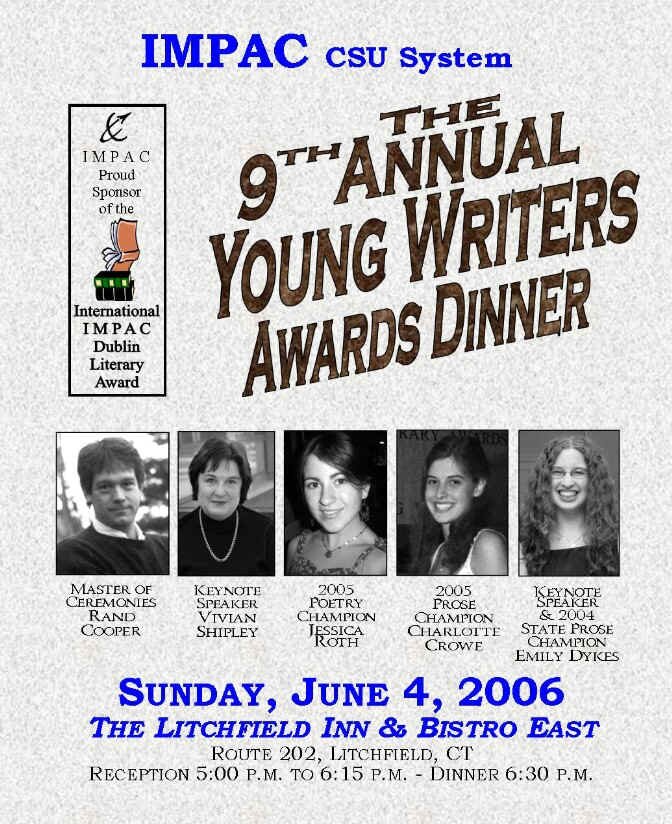
Poets and writers in each of Connecticut's eight counties win $1,000 prizes. The top poet and writer from that set of winners will earn a trip to Dublin with a parent for the presentation of the International IMPAC Dublin Literary Award and related festivities in June. Statewide poetry and prose champions will be announced during the annual dinner June 4 at the Litchfield Inn.
In addition, workshops for young writers will be held at Western on May 6-7 at Western Connecticut State University. This event is sponsored by Connecticut Review, the nationally-renowned literary journal published by the CSU System, and the Young Writers Trust. Connecticut Review published the works of 2005 statewide prose champion Charlotte Crowe of Canton and 2005 statewide poetry champion Jessica Roth of Granby in the Spring 2006 edition.
IMPAC, a leading productivity firm, also endows the International IMPAC Dublin Literary Award, which at 100,000 Euros is the world's largest prize for a single work of fiction.
IMPAC Chairman Jim Irwin and retired CSU Chancellor Bill Cibes joined to bring the Young Writers Program statewide in 2000. Newly-installed Chancellor David Carter, formerly president of Eastern, has been a champion for the program.
The CSU System serves more than 35,000 students, making it the largest public university system in Connecticut. A total of 166 academic programs are offered throughout the system, and more than 5,000 degrees are awarded annually.
2006 Litchfield County Poetry Champion Jasmine Ruiz of Torrington High
School with Dr. David Carter (right), Chancellor of the Connecticut State
University System, and Western Connecticut State University President James
Schmotter.
IMPAC-Connecticut State University Young Writers Trust
|
David Carter, CSU Chancellor
|
Jim Irwin, IMPAC Chairman
|
|
You are visitor
Top of Page
|
